Gaucher Disease:
You are not alone.
People with rare diseases often live with unexplained symptoms for years.*
.
*The average time for an accurate diagnosis for a rare disease is 4.8 years.
What Is Gaucher Disease?
Gaucher disease is a rare genetic disorder.
It is caused when not enough of an important type of protein called an enzyme is made. This enzyme called glucocerebrosidase breaks down a fatty chemical called glucocerebroside. When the body cannot break down this chemical, cells called Gaucher cells, which are filled with fat, build up in the body.
Gaucher disease is caused by a mutation in a gene that provides instructions for making a specific enzyme called glucocerebrosidase. This enzyme normally breaks down a fatty substance called glucocerebroside.
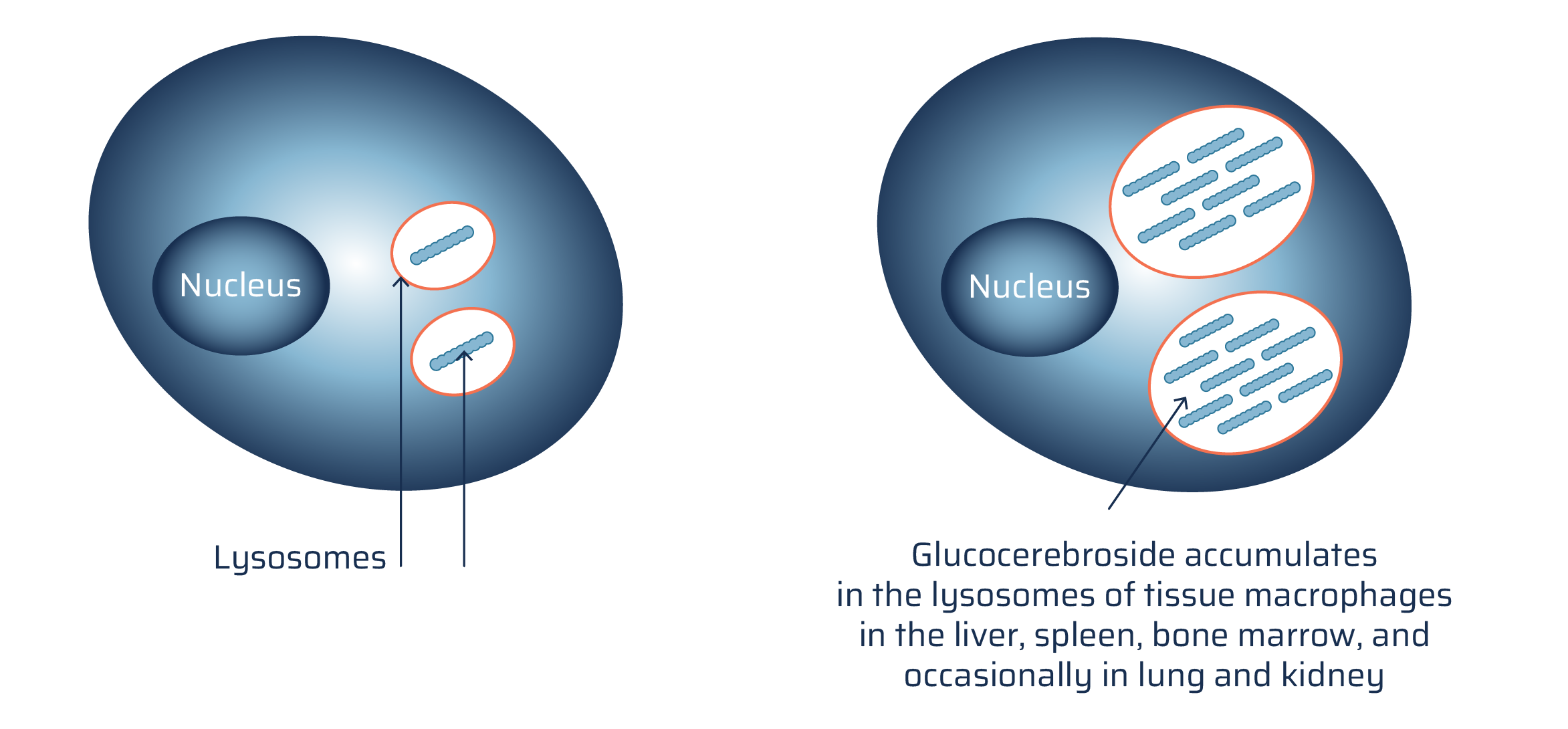
A person with Gaucher disease does not have enough glucocerebrosidase, so glucocerebroside builds up in the lysosomes and this leads to the symptoms associated with Gaucher disease.
Normal macrophage vs. macrophage cell with Gaucher disease
1 in 40,000 to 1 in 60,000 of people are born with Gaucher disease
1 in 800 in the Ashkenazi Jewish population
Signs & Symptoms
Gaucher disease is a rare genetic disorder that affects many of the body’s organs. People can have different symptoms and may be diagnosed at different stages in their life, depending on the type of Gaucher disease they have.
General symptoms include:
- Abdominal pain
- Bone pain
- Bone breaks or fractures
- Delayed growth or puberty (in children)
- Easy bruising
- Enlarged belly
- Loss of appetite
- Low red blood cell and platelet counts
Type 1 is the most common form of Gaucher disease.
What signs and symptoms do people with Type 1 Gaucher typically experience?
This visual shows the percent of people with Type 1 Gaucher disease who reported each symptom:
![A person is shown in a medical illustration with their internal organs and bones revealed. The liver and spleen are highlighted as are the knee and hip joints. This visual shows the percent of people with Type 1 Gaucher disease who reported each symptom: Bone pain 63% [points to arm bone]; bone crisis (reduced blood flow to bone tissue) 33% [points to arm bone]; enlarged spleen 87% [points to organs cutaway]; enlarged liver 79% [points to organs cutaway]; low red blood cell count 64% [points to organs cutaway]; low blood platelet count 56% [points to leg muscle]; bones become widened and flared (often near knee) 46% [points to knee x-ray]; fracture due to weakening from disease 15% [points to arm bone]; freakdown of the joints 8% [points to hip x-ray]; death of bone tissue 25% [points to leg x-ray]; low bone mineral density 42% [points to leg x-ray]; bone marrow issues 40% [points to leg bone].](/dam/jcr:76a4b315-15d5-49e0-90b5-b6e645a728f5/type1-gaucherdisease-v2.2025-10-15-19-18-03.png)
Adapted and modified from Charrow 2000, based on data from people in the Gaucher Registry.
Could your symptoms be Gaucher disease?
Three Types of Gaucher Disease
There are three types of Gaucher Disease: Type 1, Type 2, and Type 3.
Type 1 accounts for 94% of all Gaucher disease and usually does not involve the brain or spinal cord like Type 2 and 3.
Type 2 is very rare, and while children may appear normal at birth, they have issues with their nervous system by age 2 and deteriorate rapidly, often leading to death in infancy.
Type 3 often has features similar to Type 1, with a slower progression than Type 2 and patients living into adulthood.
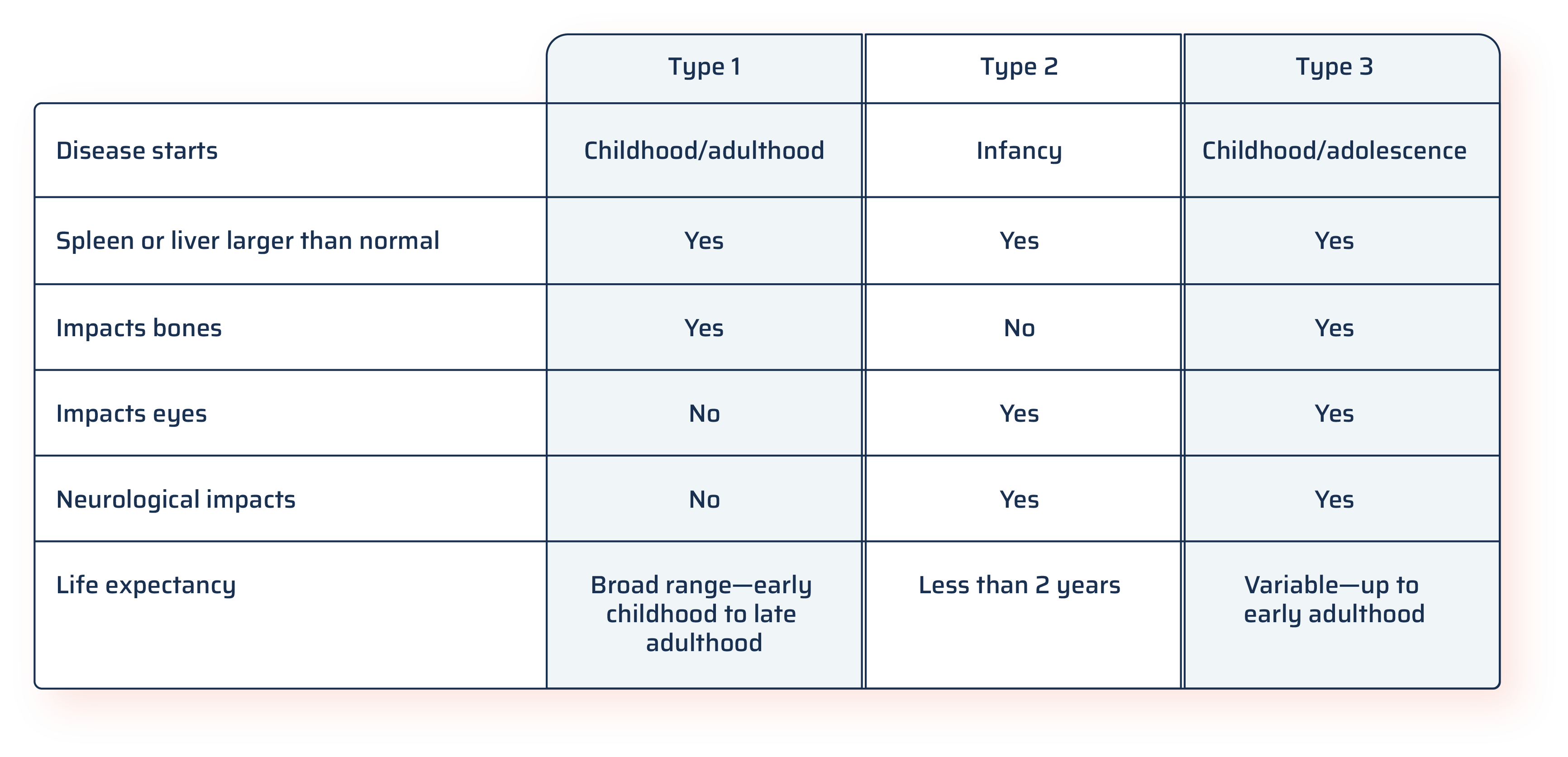
Adapted and modified from Nagral 2014.
How Is Gaucher Diagnosed?
Gaucher disease is genetic, so that means you inherit it from your parents. This disease is what’s known as an autosomal recessive condition, meaning that a person needs to inherit two affected genes, one from the mother and one from the father. If you inherit only one gene, you are a carrier for the disease and could pass it to your child, but will not experience symptoms.
To see if you have Gaucher disease, your doctor will order a blood test to look for the enzyme glucocerebrosidase. The lab will measure enzyme activity levels in the blood sample to confirm or reject a diagnosis of Gaucher disease. Your doctor may also order a genetic test for confirmation.
How Gaucher Disease is passed down
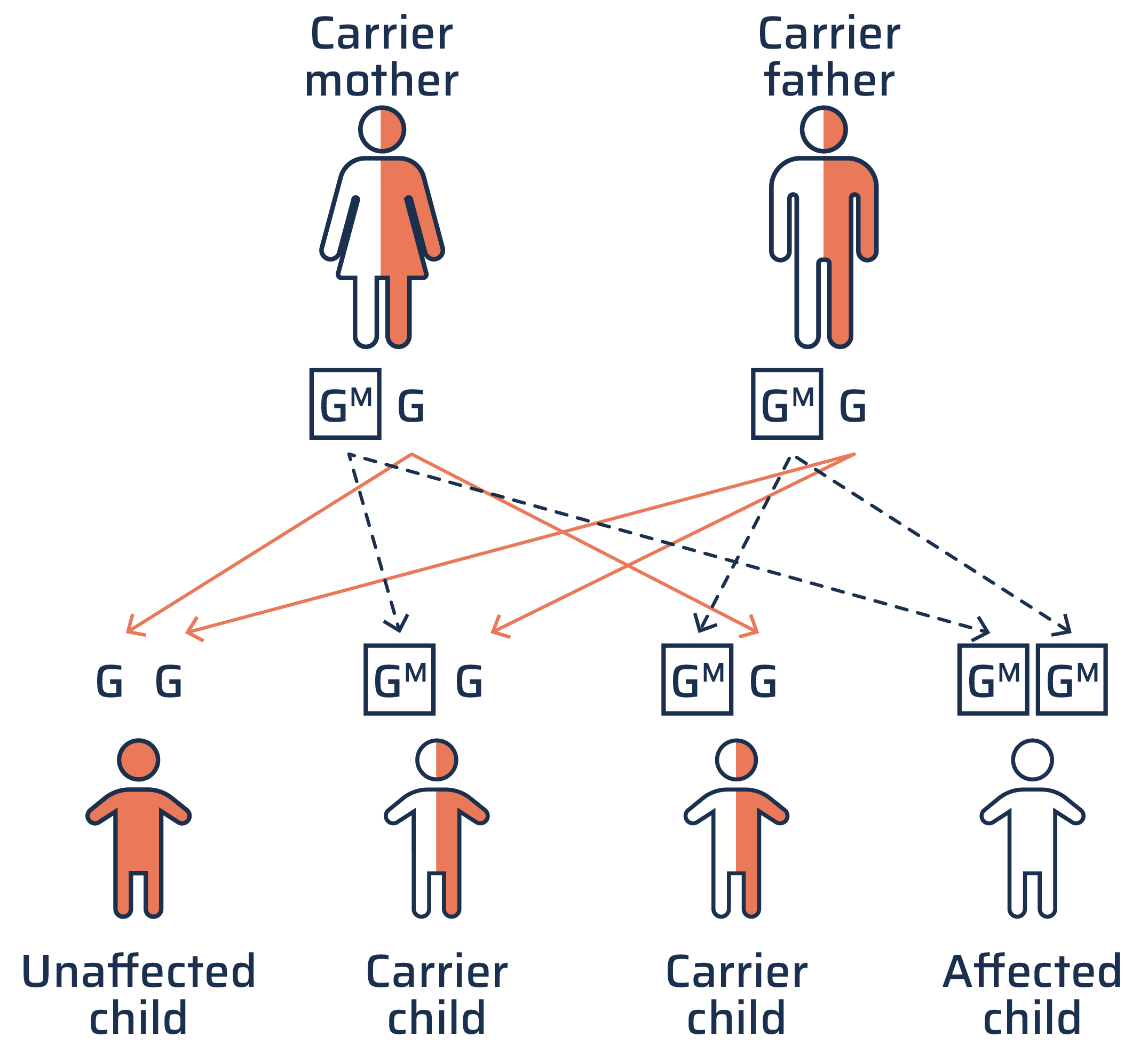
G=Normal version of gene; enough beta-glucocerebrosidase enzyme activity to break down glucocerebroside. GM=Mutated version of gene; not enough beta-glucocerebrosidase enzyme activity to break down glucocerebroside.
Early diagnosis is important as it helps minimize any
permanent damage to the body.
~50% of people with Gaucher disease were diagnosed by age 10*
*705/1441 people with Gaucher disease in the Gaucher Registry.
Treatments
There are treatments for Gaucher disease Type 1 and 3; however there is currently no treatment for Type 2. There are two main types of medications:
-
Enzyme Replacement Therapy (ERT), which provides the body with an enzyme to reduce glucocerebroside; and
-
Substrate Reduction Therapy (SRT), which inhibits the activity of an enzyme that is involved in building glucocerebroside.
These treatments may not be right for you and have the potential to cause side effects. Talk to your doctor.